

Vision Condition
Presbyopia: Symptoms, Causes, and Treatment
5 mins read

If you think about what really matters to you, in terms of your health and wellbeing, good eye care probably comes high on the list. But when you try to find out how your eyes work, you often end up drowning in Greek. So here, in plain English, is an explanation of a very common eye condition: Presbyopia.
The word literally means “old man’s eyes,” which is a rather indelicate way of saying this is an age-related condition. The term reflects the loss of elasticity of the lens in the eye, which starts from birth (when your eyes are highly elastic) and usually becomes obvious in your mid 40s to early 50s (when they are not!).
It’s all natural and normal, but it’s still annoying, because it makes it harder to read or see things close up. If you are part of an age 40+ group in a restaurant, you may see some of your fellow diners squinting as they move their menus further from their faces, trying to bring the words into focus. Or, you may be the 50-year-old struggling to read (or understand!) the emojis your kids have used in a smartphone message.
That’s Presbyopia in action!
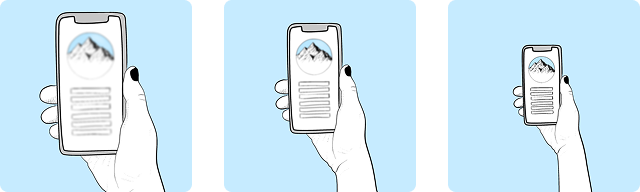
We expect things to become less robust or powerful over time. Presbyopia is simply the natural loss of the eye’s ability to focus on nearby objects. It happens to everyone.
As the lens in the eye becomes less flexible, it loses its ability to change focus quickly and accurately, especially over a range of distances. Not only do you lose your power to see as clearly as before in close-up, but you may also develop headaches through eye strain.
Symptoms of presbyopia include:
1. Blurred vision when reading or doing close-up work.
2. The need to hold reading material at arm's length to see it clearly.
3. Eyestrain or headaches after doing close-up work.
4. Difficulty focusing between near and distant objects.
The neat solution to Presbyopia is wearing a bifocal or multifocal (also known as varifocal) contact lens.
If you come across the term ‘multifocal contacts’, it describes any contact lens with multiple (more than two) powers. A bifocal contact lens delivers two prescriptions (covering near and distance vision) within one lens, while multifocal contact lenses combine a selection of different powers to correct vision.
A lot of people don’t know (or believe) such contact lenses exist. It seems amazing that a tiny sliver of translucent material can perform such wonders, but it does—correcting vision at all distances, so that near, intermediate and distant objects all stay sharp and clear when you look at them.
Some of these lenses are designed like archery targets, with concentric rings. Each alternates in power, correcting for near then distance vision from the center of the lens to its edge.
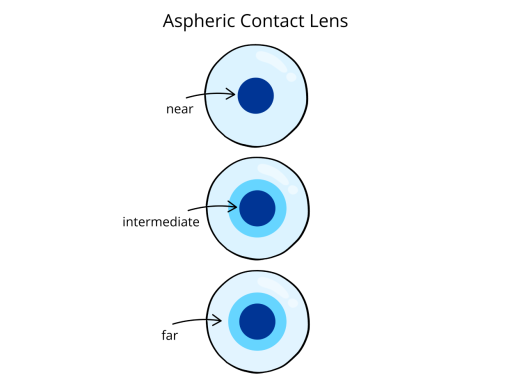
An alternative design is ‘aspheric’, which means the lens corrects for near vision at the center, then the power gradually increases outwards—initially correcting for intermediate sight needs, with the outer section used to correct for distance.
Since Presbyopia develops gradually, many people barely notice its arrival, or simply get used to poorer vision when looking at nearby objects. Although it starts slowly, one day they wake up with a sudden realization that their near vision quality has become a real problem.
Then, when they try a multifocal contact lens, the effect can be amazing. Instantly, lines become crisp, vision works at all distances, and the world becomes clear again. A smartphone becomes as easy to read as a distant road sign—and that hazy restaurant menu becomes focused, too. A previously blurry book page turns into a rediscovered joy, while the TV screen is also startlingly clear. Magic has happened!
A benefit of multifocal contact lenses is the chance to move on from a world dominated by endless pairs of glasses, where you can never find the ones you need!
No more perching them on your head, hanging them round your neck, forgetting to take them with you, or losing them around the house, airplane or work. Multifocal contact lenses spell the end of rummaging in a bag, trying to locate the right glasses.
That said, there is always a place for a backup, so most contact lens wearers like to have a pair of similarly specified physical glasses, for use when not wearing contact lenses. For very specific tasks or circumstances, like doing detailed close-up work, some people wear reading glasses on top of their lenses, though this is relatively rare.
In every case, the move from glasses (or uncorrected poor vision) to multifocal contact lenses is likely to be revolutionary. Instead of an awkward array of physical frames and lenses, you just insert your multifocal contact lenses—then forget about them.
Immediately, the lenses work at every distance: near, intermediate and across far horizons. And they do all of this simply and comfortably, without you even noticing.
If you are a glasses wearer, or someone whose perfect vision seems to be a thing of the past, which lenses should you choose, to regain effective vision at all distances?
As always, your best guide is to contact your eye doctor, whose recommendation reflects not only education and expertise, but also your specific eye condition and needs.
This consultation may point you in the direction of daily disposable multifocal contact lenses. These are examples of lenses you replace with new ones every day. Each is made from a unique material tailored to address specific needs you may have, ensuring clarity and comfort across all vision distances.
However, if you and your eye doctor determines that monthly replacement multifocal lenses would be more suitable for you, then there are monthly multifocal contact lenses that you can use all month long and then replace them with a fresh pair after 30 days that could be the right fit for your lifestyle.
By all means ask your eye doctor if they have any free trial lenses. In fact most contact lens manufacturers do offer free trial vouchers, but you should expect to pay for your initial appointment and any ongoing services (covering their time, facilities and equipment).
At your eye exam, the eye doctor will test your eyes and find the most appropriate solution, based on your specific multifocal needs. You may, for instance, have astigmatism or another condition, which responds better to one lens type than another.
The important fact—and good news—is that there is a multifocal lens for you. It can’t stop presbyopia from being a difficult word, but it can stop it from being an aggravation.
You can then make presbyopia a thing of the past – corrected and forgotten about, every day!

DAILIES TOTAL1TM MULTIFOCAL
See clearly at all distances, near through far,1,2 in a multifocal contact lens that feels like nothing.3
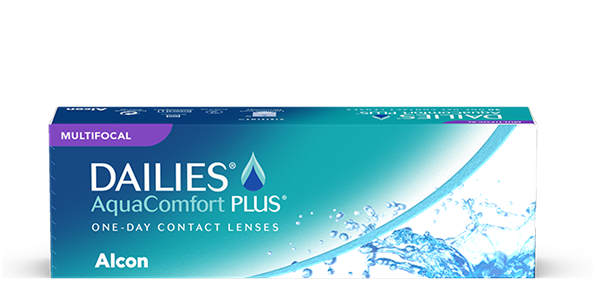
DAILIES AQUACOMFORT PLUSTM MULTIFOCAL
See clearly at all distances, near through far,2 in an affordable daily disposable contact lens that features Blink-Activated Moisture for refreshing comfort with every blink.4
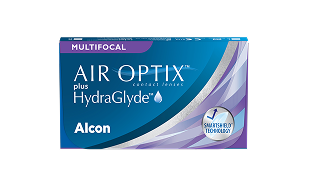
AIR OPTIXTM PLUS HYDRAGLYDETM MULTIFOCAL
See clearly at all distances, near through far,2 in a comfortable monthly replacement contact lens.5-7
REFERENCES
1. Merchea M, Evans D, Kannarr S, et al. Patient and ECP Satisfaction in the United States with a Novel Water Gradient Daily Disposable Multifocal Contact Lens. Presented at the American Optometric Association Annual Meeting, June 20-24, 2018. Denver, CO.
2. Lemp J, Kern J. Alcon multifocal contact lenses for presbyopia correction. Paper presented at the Canadian Association of Optometrists Congress; June 28-30, 2017; Ottawa, ON.
3. Perez-Gomez I, Giles T. European survey of contact lens wearers and eye care professionals on satisfaction with a new water gradient daily disposable contact lens. Clin Optom. 2014;6:17-23.
4. Pruitt J. et. al. Triple-action moisturisers for increased comfort in daily disposable lenses. Optician 2007:27-28.
5. Eiden SB, Davis RL, Bergenske PD. Prospective study of lotrafilcon B lenses comparing 2 versus 4 weeks of wear for objective and subjective measures of health, comfort, and vision. Eye & Contact Lens. 2013;39(4):290-294.
6. Based on a 30-day clinical study of 75 habitual lotrafilcon B lens wearers; Alcon data on file, 2017.
7. Lemp J, Kern J. A comparison of real time and recall comfort assessments. Optom Vis Sci. 2016;93:Eabstract 165256.
Important information for AIR OPTIX® plus HydraGlyde® (lotrafilcon B) contact lenses: For daily wear or extended wear up to 6 nights for near/far-sightedness. Risk of serious eye problems (i.e., corneal ulcer) is greater for extended wear. In rare cases, loss of vision may result. Side effects like discomfort, mild burning or stinging may occur.
See product instructions for complete wear, care and safety information. 
©2024 Alcon Inc. US-VC-2400096


