

Contact Lenses and care
Multifocal Contact Lenses: How to Choose
7 mins read

Getting older is great. With age comes wisdom and the prospect of retirement. What’s not to love? One answer is eyesight issues due to presbyopia. As we grow older, many of us need help with our vision. The good news though is that, through the innovation of multifocal lenses, clear vision remains accessible for everyone, however old we get.
From the moment we’re born, the lenses inside our eyes start losing elasticity. Once we hit 40 or 50, this loss tends to become more noticeable. Since the lens operates as our eye’s autofocus system, allowing us to see near and distant objects equally sharply, this creates an issue. Instead of clear near vision, we find it harder to focus on objects close to us, without moving them further away. That’s why the condition is often called ‘too short’ or ‘long arm’ syndrome.
But why use a fun name when you can give it a Greek one?! The scientific name for this normal condition is presbyopia. You’ll usually know you’re developing it when things slowly become less clear close up, like a blurry book page, a hard-to-read message on your mobile phone or a difficult-to-discern font on your tablet or laptop. Basically, anything within arm’s length becomes a challenge.
Symptoms of presbyopia include:
You may also notice that when you shift your gaze between different distances, it takes longer to bring them into focus. Presbyopia is separate from—and additional to—other eye conditions like near sightedness (myopia) and astigmatism. If you’re far sighted (hyperopia), you may notice the onset of presbyopia at a relatively early age, perhaps in your mid to late 30s. As soon as this blurring and confusion starts to become an issue, visit your eye doctor.
The most established form of spectacles for people with presbyopia is the simple pair of reading glasses. These correct for near vision, but if you look through them into the distance, all you see is a blur. Anyone who uses reading glasses soon gets used to pushing them down their nose—peering over the top to talk to someone, watch TV or focus on a computer screen. Hence the name ‘half-readers’.
The next step up is a pair of bifocals. As the name implies (bi meaning two), traditional bifocal lenses incorporate two different prescriptions. The top half covers distance vision and the bottom ‘window’ is for near vision, such as reading.
So with bifocals, there is no need to push these frames down to look at objects further away. You just look up, through the top half of the lens. Your grandparents probably wore (or still wear) this kind of multifocal glasses. You may have an image of them in your mind’s eye, tipping the frame or their head to ensure they’re looking through the right part of the lens.
Bifocals spectacles do a great job, so why would anyone want a better solution?
Well, they may work well at first, but as your natural lenses continue to lose elasticity, more power is needed in the bottom window for reading—and as the contrast in your prescription grows, intermediate images become increasingly blurry. It’s time for multifocals, letting you see clearly and seamlessly at all distances, from near to far.

Of course, you could select multifocal glasses, but there’s an alternative and arguably better option. The wonderful thing about a multifocal contact lens is that it does everything multifocal glasses can do, without having to move your head or be aware of the transition from one viewing distance to another. No one will ever guess you’re presbyopic: You simply wear these modern wonders of science and let them do all the adjusting work for you.
They do this through ‘concentric’ alternating rings of different powers, or an ‘aspheric’ design, which increases or decreases the power gradually from the center outwards.
Most designs follow the latter approach, correcting for near distances at the center, then covering intermediate distances before using the outer section to deal with objects further away (correcting the underlying myopia or hyperopia). If you already have good distance vision, the outer section won’t have any correction function at all.
Each design sees the multifocal contact lenses focus light from all distances onto the retina, so as a contact lens wearer you get to see close-up text, computer screens and the horizon with equal ease and clarity. Just adjust your gaze to enjoy clear vision in all dimensions and directions. You’re back to a time when everything about your eyes simply … worked.

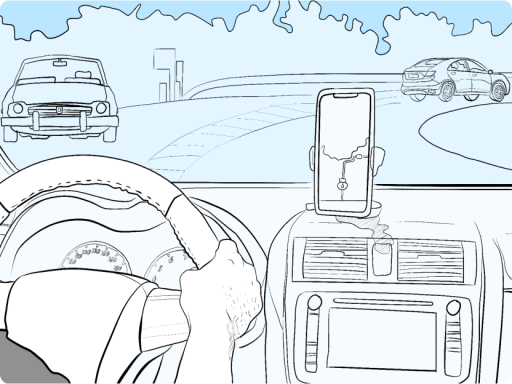
Multifocal contact lenses are versatile and designed for a range of activities. Ideal for everyday tasks like reading or shopping, they also enhance clarity while driving, participating in sports, and engaging in outdoor activities.
Their unobtrusive nature makes them a preferred choice for social events and professional settings alike. Whether traveling, working, or just enjoying life's moments, these lenses cater to varied visual demands, providing a seamless transition between near and distant views. However, maintaining good eye hygiene and following recommended wear schedules is vital for optimal performance and eye health. Always consult an eye doctor for guidance.
As with multifocal eyeglasses, it may take a while to adapt. Getting used to multifocal contact lenses might take you just an hour or so, or a day or two. For a few people, adjusting takes a little longer, for some no time at all. Yet once your eyes and brain have adapted to the new way of seeing, multifocal magic becomes a daily joy.
Instead of juggling spectacles and their cases, you can see a menu as clearly as a shop sign and your phone as crisply as a distant animal. Instead of hanging glasses round your neck or perching them on your head, you’re free to forget you ever needed vision correction, even when driving.
You may keep a set of glasses for evenings or as a back-up. You may prefer to swap your lenses for reading spectacles when in bed, wanting to complete your night preparations and take out your lenses before drifting off to sleep. If you do specialized close-up tasks like model-building, you may wear glasses over your contact lenses. But apart from these rare moments, your liberation is complete!
Your multifocal adventure should start with the guidance of your eye doctor. Daily disposable multifocal contact lenses are worn once and then discarded. They offer convenience as there's no need for cleaning or storage. However, they can be more expensive since you need a fresh pair every day. On the other hand, monthly replacement multifocal contact lenses can be worn for a month before replacement. If these lenses are worn as daily wear, they will require daily cleaning and disinfecting. This may be more cost-effective per day. The decision depends on personal preferences, budget, and lifestyle factors.
Multifocal contact lenses, designed to provide clarity at varying distances, are a valuable choice for many. They eliminate the inconvenience of swapping between different glasses, offering a seamless and natural viewing experience. Modern advancements in lens technology ensure utmost comfort and clarity, making them ideal for those with an active lifestyle or who prefer a glasses-free appearance. Furthermore, their versatility can be cost-effective in the long run, eliminating the need for multiple pairs of glasses. While the initial transition may require some adaptation, the benefits of a wide and uninterrupted field of vision, coupled with aesthetic appeal and lifestyle freedom, make multifocal lenses a commendable vision solution. As always, consultation with an eye doctor is essential for the best results.

DAILIES TOTAL1TM
Multifocal
See clearly at all distances, near through far,1,2 in a multifocal contact lens that feels like nothing.3
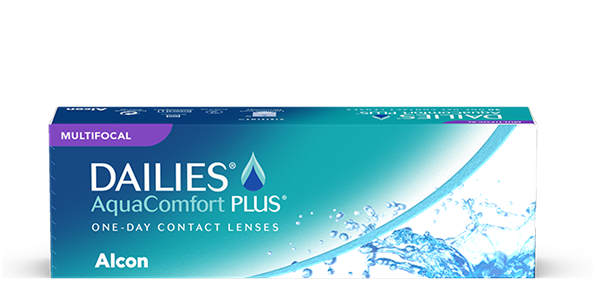
DAILIES AQUACOMFORT Plus® MULTIFOCAL
See clearly at all distances, near through far,2 in an affordable daily disposable contact lens that features Blink-Activated Moisture for refreshing comfort with every blink.4

TOTAL30TM
Multifocal
Finally, a monthly replacement lens designed for ultimate comfort. See clearly at all distances, near through far,2 in a comfortable monthly replacement contact lens.5,6
REFERENCES
1. Merchea M, Evans D, Kannarr S, et al. Patient and ECP Satisfaction in the United States with a Novel Water Gradient Daily Disposable Multifocal Contact Lens. Presented at the American Optometric Association Annual Meeting, June 20-24, 2018. Denver, CO.
2. Lemp J, Kern J. Alcon multifocal contact lenses for presbyopia correction. Paper presented at the Canadian Association of Optometrists Congress; June 28-30, 2017; Ottawa, ON.
3. Perez-Gomez I, Giles T. European survey of contact lens wearers and eye care professionals on satisfaction with a new water gradient daily disposable contact lens. Clin Optom. 2014;6:17-23.
4. Pruitt J. et. al. Triple-action moisturisers for increased comfort in daily disposable lenses. Optician 2007:27-28.
5. In a clinical study wherein patients used CLEAR CARE solution for nightly cleaning, disinfecting, and storing; Alcon data on file, 2021.
6. Alcon data on file, 2022.
Ask your eye care professional for complete wear, care and safety information. 
©2024 Alcon Inc. US-VC-2400095


