

Vision Condition

The first thing to say about astigmatism is that there’s nothing to worry about.
Astigmatism is a very common eye condition and highly unlikely to be anything other than an eye condition with easily available solutions. So don’t waste time getting anxious if your eye doctor tells you that you’re astigmatic. A solution is just around the corner!
What causes astigmatism?
Before looking at options designed to correct astigmatism, you may want to know more about what causes the condition. If you are astigmatic, the chances are it is because your cornea is not a spherical curve but is shaped more like a football. The cornea is the transparent part of the eye in front of the colored iris containing your pupil. It acts like a first lens, bending light rays before they reach the actual lens in your eye—and finally the back of the eye (your retina).

Normally the front of the cornea is a sphere. With astigmatism, it is more like a football. This makes the optics a bit more complicated. If the lens inside your eye (behind the cornea) is also not uniform in shape, it can add to the astigmatic effect or reduce it.
If the cornea shape resembles a football, you have ‘regular’ astigmatism, but if there are additional uneven curves with variable steepness, you have ‘irregular’ astigmatism. Sometimes mild astigmatism is hardly noticeable. However, the more pronounced it is, the more you need corrective lenses to help you see in focus.
How does astigmatism cause blurred vision?
So, what goes wrong, causing all this fuzziness? With 20/20 vision, light rays entering your eye focus at a single point (like sunlight when using a magnifying glass) on your retina—the ‘screen’ at the back of your eye. This gives the retina one clear image, like a sharply focused film projection at the cinema.
With astigmatism, the eye creates more than one focal point, projecting somewhat blurred or distorted images onto the retina. This sends multiple images to the brain, so instead of a clear picture you get a lack of focus. You may perceive this as a general haze, or through small differences in how sharp or straight horizontal and vertical lines appear in a building, tree or other structure. The effect is more pronounced when driving at night.
All of this explains why astigmatism was defined by its discoverer the Rev. William Whewell simply as “a defect in the structure of the eye whereby the rays of light do not converge to a point upon the retina." This was way back in 1849, with the term combining the Greek for ‘without’ and ‘stigmatos’ meaning a mark, spot or puncture.
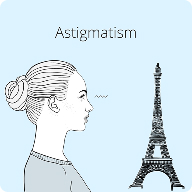
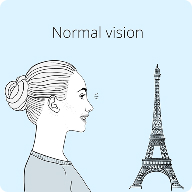
Enough of the history. Tell us about the effects.
Well, even a minor case of blurred sight can cause headaches and eye strain, as your brain tries to make sense of what you are looking at. You may also feel tired, irritated eyes and struggle to see clearly. As noted, this is especially likely when driving at night. That’s because astigmatism can turn light sources into flares and glare, surrounded by starburst haloes. It’s like fireworks night, just less exciting and more dangerous!
Where astigmatism comes from
Most people with astigmatism are born with it, though it can develop in later life. Like many eye conditions, it may be an unwanted inherited gift from your parents: if your parents have it, you’re more likely to have it too. In some cases though, it can be a result of trauma or other problems with your eye changing the shape of your cornea.
So, what do I DO about the condition?
Let’s assume you do indeed have astigmatic eyes. The condition will not disappear on its own, but sorting it out is fairly straightforward. See your eye doctor, get your vision checked, then choose your correction solution: contact lenses, glasses or refractive (LASIK / LASEK) surgery. This is where the word ‘toric’ becomes important to our story. A torus is basically a tubular ring, like a donut. Imagine a thin vertical slice of that donut’s ring. That’s the shape of the ‘toric’ part of a contact lens. Since it has different powers to bend light at different points of the lens shape, a toric contact lens refocuses the rays coming into your eye, ensuring that they meet at a single point on your retina.
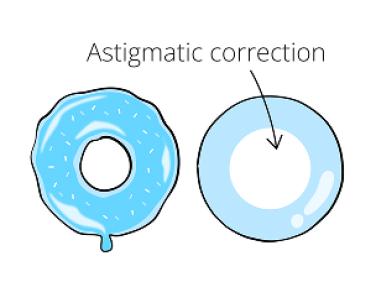
So the contact lens I need is...
Toric contact lenses for astigmatism! These days, contact lenses are arguably the best and easiest way to correct astigmatism. A toric contact lens keeps doing its great work all day long. With a huge range of lens types, materials, fitting shapes, powers and designs, there are toric lenses for almost every type of astigmatic correction and personal preference, including daily disposables and monthly replacement lenses. You can add the convenience and hygiene of daily disposable lenses to the secure and stable fit of a toric lens. Alternatively, you and your eye doctor may decide to choose a monthly replacement contact lens format. Made from silicone hydrogel, these toric contacts not only correct your vision, they also let oxygen reach your cornea. If you have a particularly high level or irregular astigmatism, lenses can be custom-made especially for you. In extreme cases, hybrid or scleral lenses (which create a tear-filled vault over the cornea) can still deliver excellent vision. Science has moved on in leaps and bounds, ensuring no one with astigmatism should ever be denied their ideal contact lens.
What next?
So, whatever your preference, if you’re seeing vertical or horizontal blurred lines, often getting headaches or suffering from poor night vision, a visit to your eye doctor to explore contact lenses for astigmatism is a very good idea. It could make ‘toric’ your favorite new word!
Products You Might Be Interested In
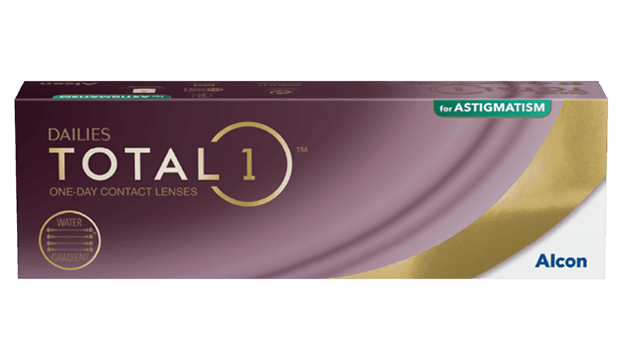
DAILIES TOTAL1™ FOR ASTIGMATISM
Feel exceptional comfort with the first and only daily disposable Water Gradient contact lens for astigmatism.1
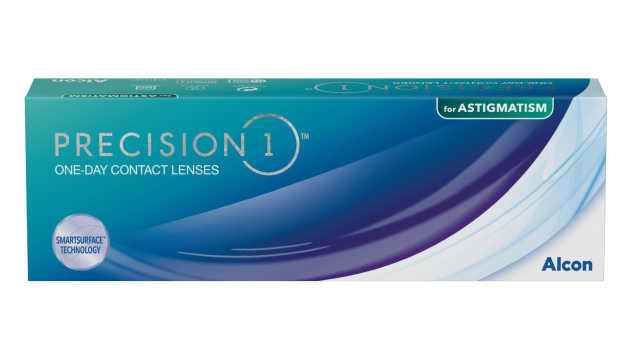
PRECISION1™ FOR ASTIGMATISM
Precise vision and dependable comfort2 in an easy-to-wear, easy-to-love daily disposable contact lens for astigmatism.
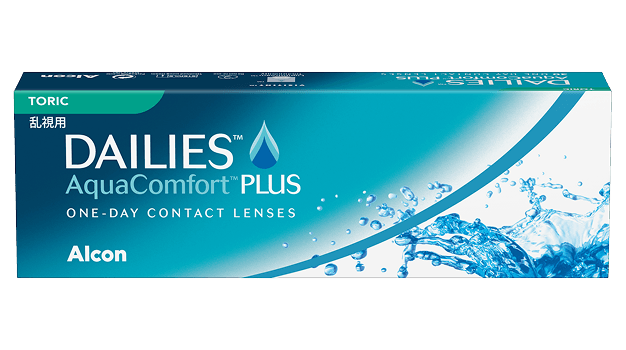
DAILIES™ AQUACOMFORT PLUS™ TORIC
Affordable daily disposable contact lens featuring Blink-Activated Moisture for refreshing comfort with every blink,3 plus clear vision even with astigmatism.
REFERENCES
1. In a clinical trial to assess overall performance of DAILIES TOTAL1™ for Astigmatism lenses where n=134 patients; Alcon data on file, 2021.
2. Perez-Gomez I, Valente R, Vonbun H. Survey of patient and ECP satisfaction with a new daily disposable toric contact lens. Poster presented at 2021 American Academy of Optometry Annual Meeting; November 3-6; Boston, MA.
3. Pruitt J. et. al. Triple-action moisturisers for increased comfort in daily disposable lenses. Optician 2007:27-28.
4. Lemp J, Kern J. A comparison of real time and recall comfort assessments. Optom Vis Sci. 2016;93:Eabstract 165256.
5. Eiden SB, Davis RL, Bergenske PD. Prospective study of lotrafilcon B lenses comparing 2 versus 4 weeks of wear for objective and subjective measures of health, comfort, and vision. Eye & Contact Lens. 2013;39(4):290-294.
6. Based on a 30-day clinical study of 75 habitual lotrafilcon B lens wearers; Alcon data on file, 2017.
7. In a randomized, subject-masked, multi-site clinical study with over 150 patients; significance demonstrated at the 0.05 level; Alcon data on file, 2005.
Ask your eye care professional for complete wear, care and safety information. 
©2024 Alcon Inc. US-VC-2400083
Related Articles
The World of Monthly Contact Lenses
Monthly Replacement vs. Daily Disposable Contact Lenses
Nearsightedness: Symptoms, Causes, and Treatment


