Extended Depth
Of Focus (EDOF) Intraocular Lens (IOL)
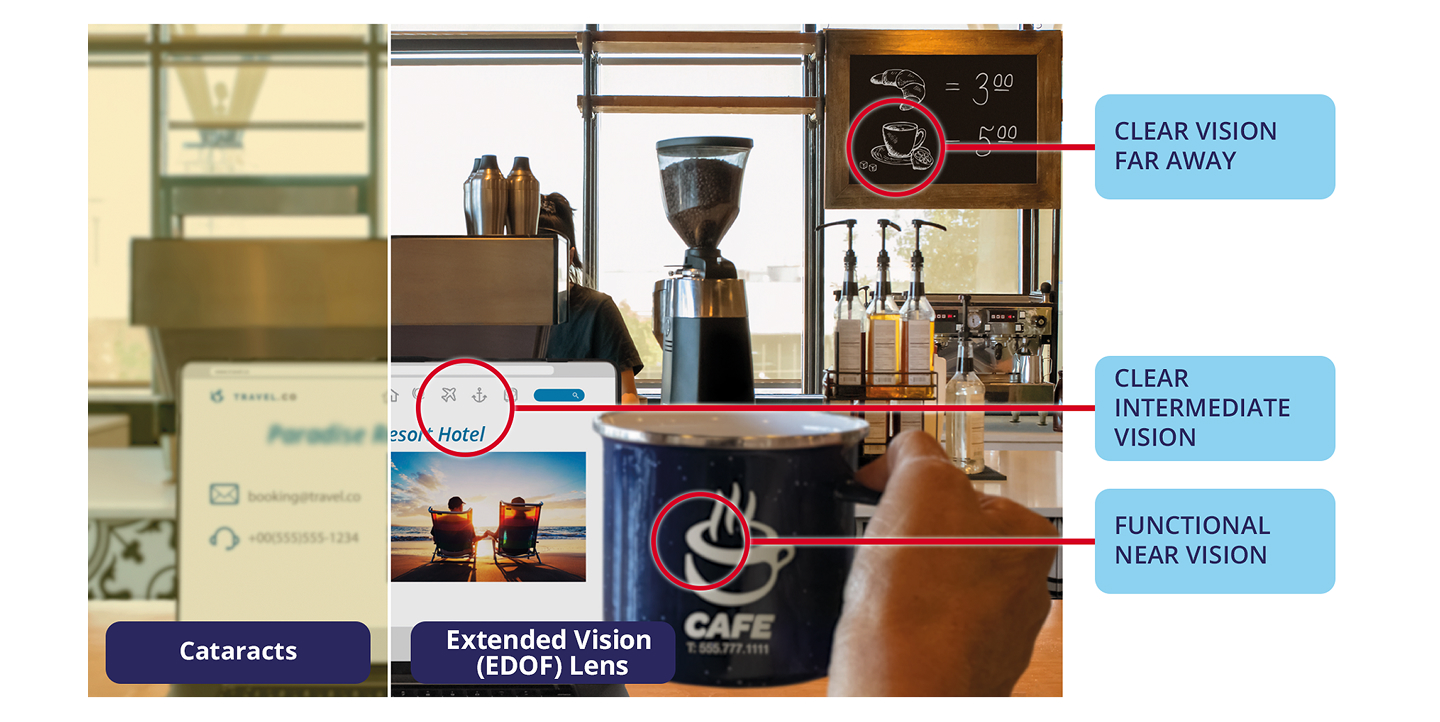
Allows you to see clearly at the crucial far and intermediate distances while still providing functional near vision.1-3
Extended Depth Of Focus (EDOF) Intraocular Lens (IOL)
Allows you to see clearly at the crucial far and intermediate distances while still providing functional near vision1-3
Experience Clarity For Everyday Tasks4‡
The EDOF IOL is a kind of presbyopia-correcting IOL. Unlike traditional monofocal lenses, it allows you to treat cataracts while addressing presbyopia, myopia and astigmatism in 1 surgery.1-3,5‡

See Clearly with Low Levels of Visual Disturbances1-3,5*¶
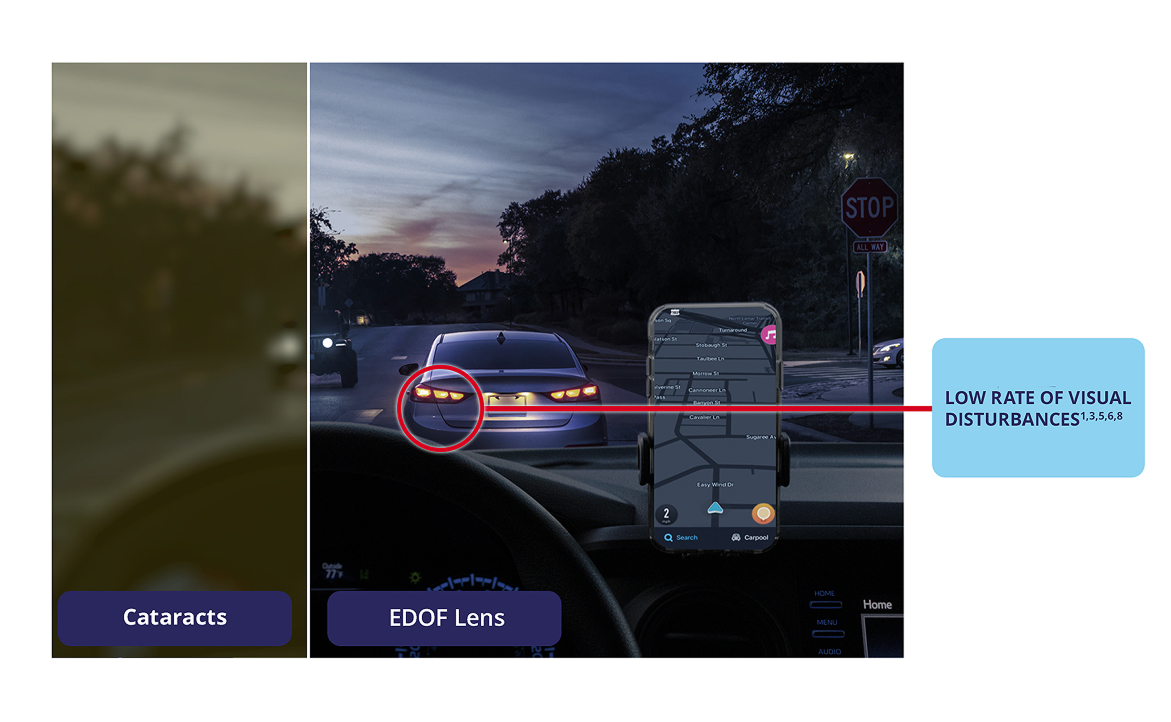
EDOF IOLs are designed to combine two major advantages: continuous clear vision from far to intermediate and functional at near, with a low rate of visual disturbances like halos, glares, or starburst.1,3,5*¶§ Enjoy a full range of daily activities with reduced dependence on glasses, and approach nighttime activities, like driving, with more confidence.1,3*
*Clinical studies were performed on EDOF IOLs.
‡97% of patients reported no or some difficulty with their sight for activities in everyday life. Based on response of ”no, no difficulty” or “yes, some difficulty” to the question “Do you find that your sight at present in some way causes you difficulty in your everyday life?”; n=874.
¶Results from a prospective, randomized, parallel group, subject- and assessor-masked, multisite trial of 107 subjects bilaterally implanted with an EDOF IOL, and 113 with a standard IOL with 6 months’ follow-up.
§Results from a prospective, multi-country randomized controlled trial of 159 subjects implanted with the an EDOF OL and 123 with a standard IOL with 6 months’ follow-up.

Benefits of EDOF IOLs

The continuous range of vision (clear distance, clear intermediate, functional near).1,3,5*¶
Enjoy a full range of daily activities with reduced dependence on glasses.1,3*
Low levels of patient-reported visual disturbances.1,3,5,6¶§
Approach nighttime activities, like driving, with more confidence.1,3*
*Clinical studies were performed on EDOF IOLs. ¶Results from a prospective, randomized, parallel group, subject- and assessor-masked, multisite trail of 107 subjects bilaterally implanted with §EDOF IOL, and 113 with a standard IOL with 6 months’ follow-up §Results from a prospective, multi-country randomized controlled trail of 159 subjects implanted with the an EDOF OL and 123 with a standard IOL with 6 Months follow-up.
Know Your Options. Put Your Future in Focus.
The EDOF IOL gives you a continuous range of vision, so that you can immerse yourself in a full range of activities—all while relying less on glasses.1,2
Here’s a visual example to help you understand the kind of vision improvements that come with an EDOF IOL.
Frequently Asked Questions About EDOF IOLs
Get the information you need to guide you to an informed decision about the cataract lens replacement that best fits your budget and your lifestyle.
The EDOF IOL, or extended depth of focus intraocular lens, is a type of lens that is used to replace the natural lens of the eye during cataract surgery. It is also referred to as an extended vision lens.
This type of lens is designed to provide a continuous range of vision from far to intermediate with functional near vision, reducing the need for glasses or contact lenses.1-3,5,9 EDOF IOLs work by creating a gentle blending of the light that enters the eye, which helps to improve contrast sensitivity and reduce glare, making it easier to see in different lighting conditions.10 EDOF IOLs are a great option for people who want to reduce their dependence on glasses or contact lenses and have improved vision in dim light after cataract surgery.4
You have options when it comes to cataract surgery. Choosing the right IOL lens for your needs is a personal decision that should be discussed with your eye surgeon. The extended depth of focus (EDOF) IOL is generally a good option for people who:
• Want to reduce their dependence on glasses: EDOF IOLs are designed to provide clear distance, clear intermediate and functional near vision, which can reduce the need for glasses or contacts.1
• Have realistic expectations: While EDOF IOLs can improve vision at multiple distances, they do not completely eliminate the need for glasses or contacts. You may need glasses for detailed near-vision tasks, such as reading fine print.
• Need good vision for night driving and low-light conditions: EDOF IOLs have a low rate of visual disturbances like halos, glare or starbursts.1-4
• Are willing to pay some of the cost out-of-pocket: Due to its advanced technology, EDOF IOLs are typically more expensive than monofocal lenses, which may be a consideration for some patients.
EDOF IOL lenses are considered premium lenses. Typically, an insurance company will not cover elective parts of cataract surgery, including premium types of IOL and laser-assisted cataract surgery.11 This means that, if you want these, you will pay out of pocket for at least part of the procedure. But if the possibility of reducing the dependence on glasses and minimizing visual disturbances is important to you, the benefits may outweigh the cost. [Learn more about the cost of cataract surgery and insurance coverage.] LINK TO: /cost-and-insurance-coverage
Yes, there are EDOF toric IOLs that are suitable for people with astigmatism. Ask your doctor to learn more about your options.1
The journey to clear vision after cataracts starts with knowing the difference between cataract replacement lens options.
Learn about your options to find the right type of IOL for you.
Consult your doctor about the available treatment options/products and on the relevant safety information.
Please refer to relevant product direction for use for complete list of indications, contraindications and warnings.
REFERENCES
1. Alcon Data on File, 2024. [REF-25409]
2. Alcon Data on File, 2022. [REF-15172]
3. Alcon Data on File, 2023. [REF-25718]
4. McCabe C, Berdahl J, Reiser H, et al. Clinical outcomes in a U.S. registration study of a new EDOF intraocular lens with a nondiffractive design. J Cataract Refract Surg. 2022;48(11):1297–1304.
5. Bala C, Poyales F, Guarro M, et al. Multicountry clinical outcomes of a new nondicractive presbyopia-correcting IOL. J Cataract Refract Surg. 2022;48(2):136–143.
6. Alcon Data on File, 2019. [REF-03959]
7. Alcon Data on File, 2019. [REF-01412]
8. MacMillan C. New Cataract Surgery Options Can Restore Your Vision. Yale Medicine. https://www.yalemedicine.org/news/ cataractsurgery-options. Updated August 18, 2022. Accessed June 16, 2025.
9. How Much Does Cataract Surgery Cost? UCF Health Website. https://ucfhealth.com/our.services/ophthalmology/cataract-surgery-cost/. Accessed on March 6, 2025.