Cataract Surgery,
Step-By-Step
What to know before you visit your doctor.
Be prepared and lead the conversation with confidence.
Cataract Surgery, Step-By-Step
What to know before you visit your doctor. Be prepared and lead the conversation with confidence.
What to Expect with Cataract Surgery
Have you or someone you love been diagnosed with cataracts?
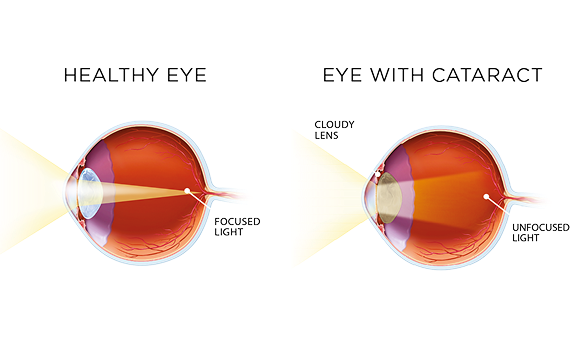
Cataracts are a normal part of aging. Cataracts form gradually as our eyes get older. Over 100 million people worldwide are affected by cataracts and 90% of people develop them by the time they're 65.1,2 The good news is that cataract surgery is one of the safest, most common, and most effective procedures performed today.2,3
Cataract surgery is a routine procedure that involves removing the natural lens in the eye that has become cloudy and replacing it with an artificial lens (known as an intraocular lens or IOL). The only way to treat cataracts is through cataract surgery.3 This highly successful procedure has a proven safety profile, and is performed by an ophthalmologist in less than 30 minutes.3,4*
*As any surgery, cataract surgery has risks too, and individual outcomes may vary. Please contact your doctor to discuss any safety-related questions about the treatment.

During surgery, your doctor will replace your clouded lens with an IOL
You will receive local anesthetics to numb the area around your eye and you may be given a sedative to help you relax.5 Through a tiny incision, the surgeon removes your clouded lens and replaces your original lens with the IOL lens.

Recovery after cataract surgery is usually very quick
You will likely be able to go home on the same day as your surgery. Within a few days, patients can typically return to their daily activities, with vision improving over time.5

After surgery, your doctor will monitor the healing process
Eye drops may be prescribed to prevent infection or reduce inflammation. Patients usually see their ophthalmologist a day or two after surgery, the following week, and then again after one month.5
Intraocular lenses (IOLs) are used in cataract surgery to replace the natural lens of the eye. Extraction of a cataract and replacement with an IOL will require surgery and all surgery carries risks. Please consult your eye care professional to determine if this product is right for you. If you experience any symptoms, consult your eye care professional as the symptoms may be a sign of other eye problems.
Frequently Asked Questions About Cataract Surgery
Get the information you need to guide you to an informed decision about the cataract lens replacement that best fits your budget and your lifestyle.
Cataract surgery generally lasts less than half an hour, usually 10–20 minutes.6 You will be given local anesthetics to numb the area around your eye and sometimes, a sedative to help you relax.5 There are several factors that can affect cataract surgery operating time including how advanced the cataract is, your medical health, and even your pupil size. It is important to follow any pre-operative instructions given to you by your doctor to ensure the procedure runs as smoothly as possible.
If you have cataracts, there are various possibilities when it comes to the kind of vision you want after cataract surgery. Talk to your doctor about your treatment options as well as your vision goals, if you are considering cataract surgery.
Each person who undergoes cataract eye surgery has a unique recovery experience. Many people are able to return to their daily activities within a few days. Others might experience side effects, such as mild discomfort, itching, or inflammation. After the surgery, your doctor may prescribe medication or eyedrops to help reduce any discomfort and prevent infection.5
After surgery, your doctor will monitor your healing progress at scheduled appointments a day or two after surgery, the following week, and then again after one month.5
They will give you detailed instructions on what to expect during the recovery period.
Consult your doctor about the available treatment options/products and on the relevant safety information.
Please refer to relevant product direction for use for complete list of indications, contraindications and warnings
REFERENCES
1. Cataract. University of Michigan Health. Accessed December 1, 2025. https://www.umkelloggeye.org/conditions-treatments/cataract.
2. Burton MJ, Ramke J, Marques AP, et al. The Lancet Global Health Commission on Global Eye Health: vision beyond 2020. Lancet Glob Health. 2021;9:489-551. doi: 10.1016/S2214-109X(20)30488-5.
3. Cataracts. National Eye Institute. Updated November 26, 2025. Accessed December 1, 2025. https://www.nei.nih.gov/learn-about-eye-health/eye-conditions-and-diseases/cataracts.
4. Alcon Advanced Lenses. Preparing For Surgery. Accessed June 11, 2025. https://seethefullpicture.myalcon.com/cataract-surgery/.
5. Cataract Surgery. Mayo Clinic. Updated September 9, 2023. Accessed December 1, 2025. http://www.mayoclinic.org/tests-procedures/cataract-surgery/basics/what-you-can-expect/prc-20012917.
6. Haddrill M. Cataract surgery recovery: 8 tips to minimize recovery time. All About Vision. February 26, 2019. Accessed September 17, 2025. https://www.allaboutvision.com/treatments-and-surgery/vision-surgery/cataract/cataract-surgery-recovery/.