Intraocular Lenses for Cataract Surgery
See the World
Clearly Again
Cataracts are a clouding of the eye’s natural lens—it’s a normal part of aging.1 Along with guidance from your eye doctor, the information here will help you understand your cataract treatment options and next steps.
Intraocular Lenses for Cataract Surgery
See the World
Clearly Again
Cataracts are a clouding of the eye’s natural lens—it’s a normal part of aging.1 Along with guidance from your eye doctor, the information here will help you understand your cataract treatment options and next steps.
Sidhu Hits It Out Of The Park With Brilliant Vision
If you’ve been advised cataract surgery, consult your eye specialist about advanced lens implant options like Trifocal or Extended Vision, tailored to your visual needs.
Understanding Cataract Symptoms
Be sure to discuss your symptoms with your eye care professional.
With cataracts, you may experience symptoms such as1:
- Blurred vision
- Trouble seeing at night
- Light and glare sensitivity
- Seeing halos around lights
- Fading or yellowing of colours
- Double vision
- Frequent changes to your vision precriptions
IOL Lens Options
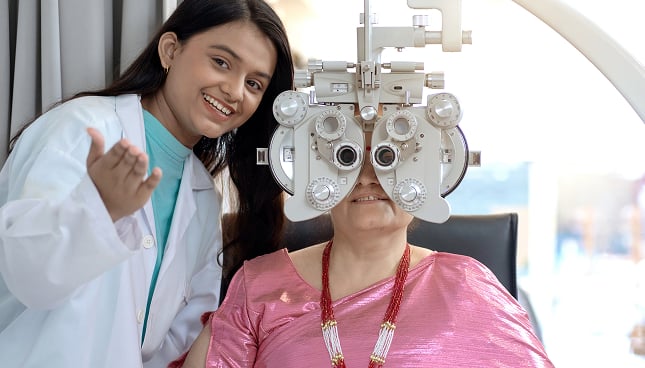
Not all intraocular lens (IOLs) are the same – their design, shape, and material quality play a crucial role in delivering immediate visual results after surgery and ensuring long-term performance.2 IOLs are used by millions of patients worldwide.3 Learn more about the various lens options to meet your lifestyle needs and preferred level of spectacle independence.
Trifocal IOLs
Enjoy a full range of vision, far away, at arm’s length, and up close, with spectacle independence.4-6
Extended Depth of Focus (EDOF) IOLs
See clearly far away and at arm’s length, with functional near vision and minimal night-time visual disturbances.7-10
Advanced
Monofocal IOLs
Provides excellent distance and functional intermediate vision. Patients usually require glasses for clear near vision.11,12
Advanced Monofocal Toric IOLs
Provides sharp, crisp distance vision and functional intermediate vision while correcting astigmatism at the same time.11-13
Compare the Images to Discover Your IOL Options
Discuss your IOL options with your surgeon to ensure you receive the IOL most suited to your needs. How glasses-free would you like to be?
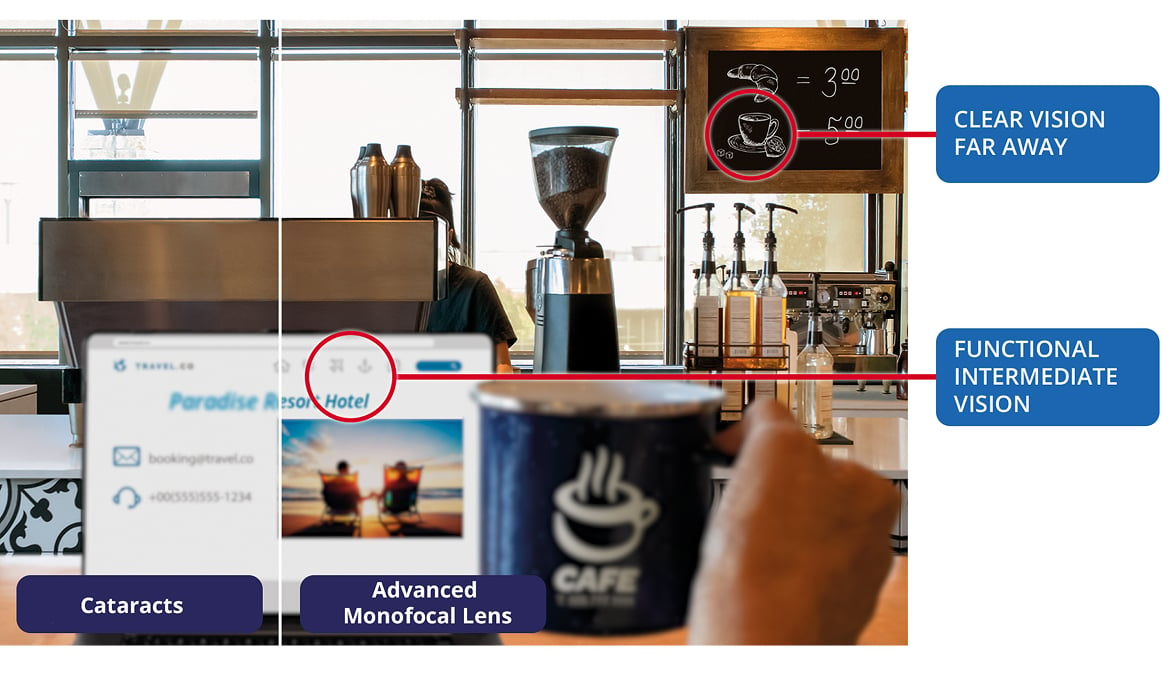
ADVANCED MONOFOCAL LENS (DAYTIME)
Clear distance and functional intermediate vision11
ADVANCED MONOFOCAL LENS (NIGHTTIME)
Clear distance and functional intermediate vision11
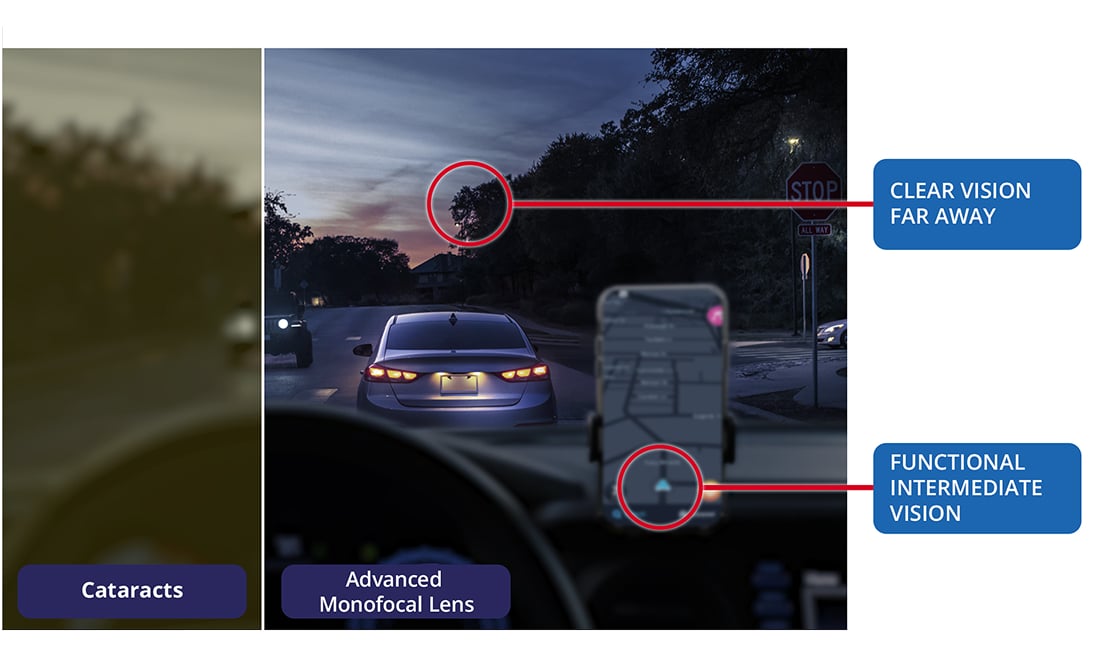
For illustration purposes only; personal experiences may vary.
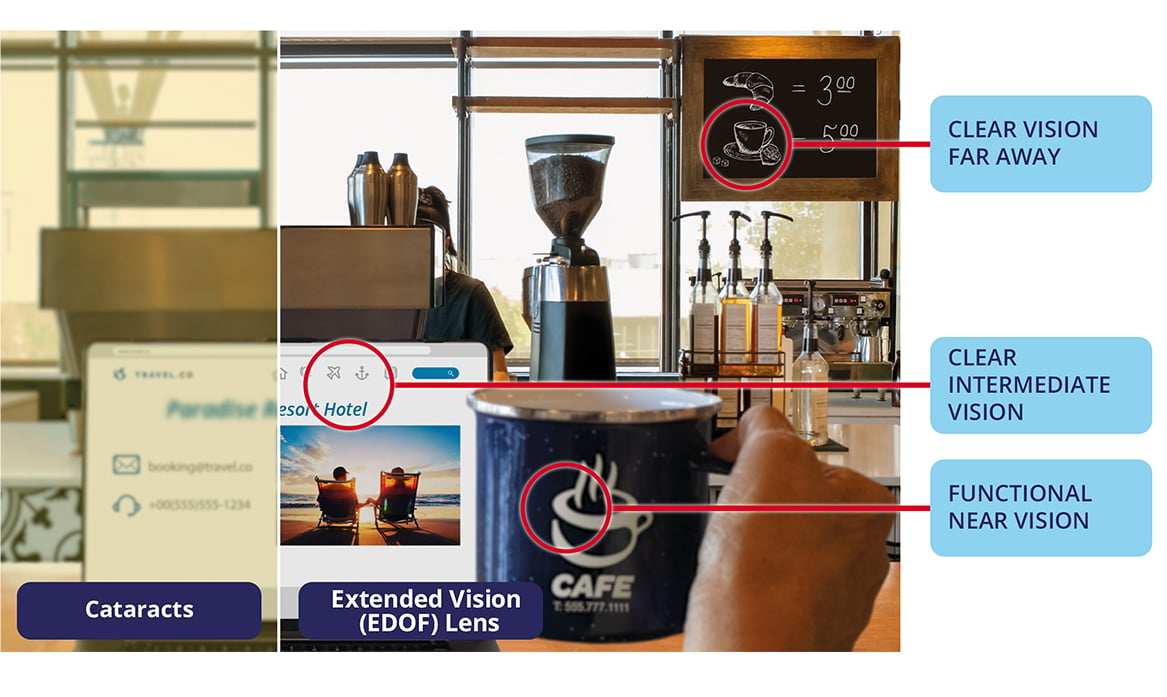
EXTENDED DEPTH OF FOCUS (EDOF) LENS (DAYTIME)
Clear distance, clear intermediate and functional near vision7-9
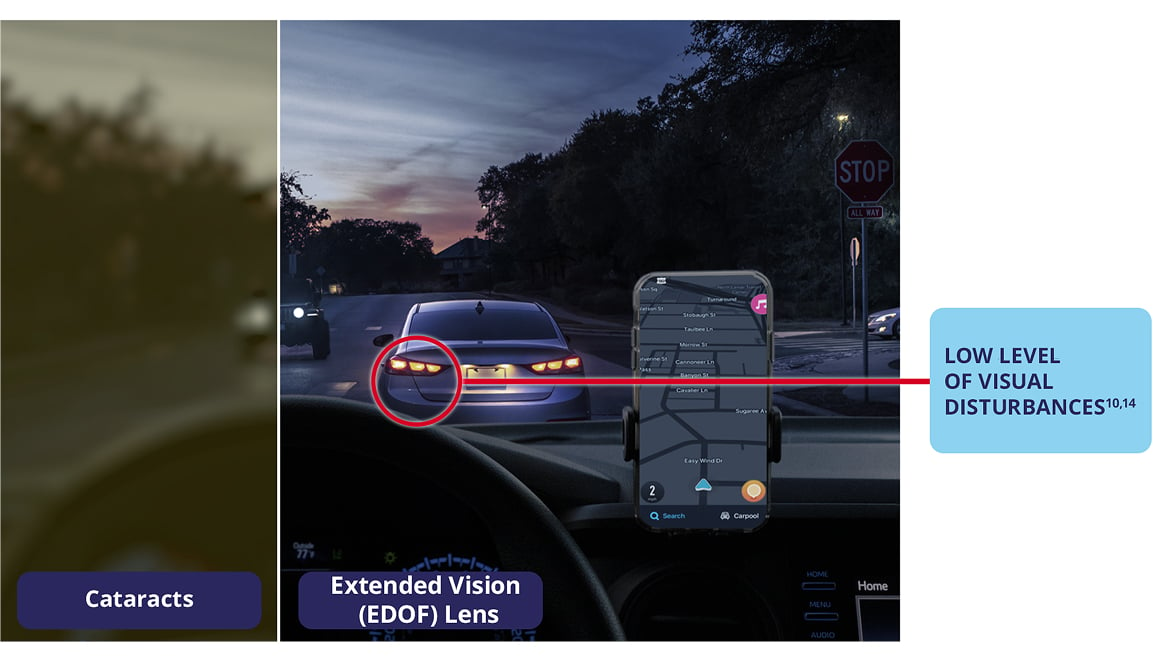
EXTENDED VISION (EDOF) LENS (NIGHTTIME)
Clear distance, clear intermediate and functional near vision7-9
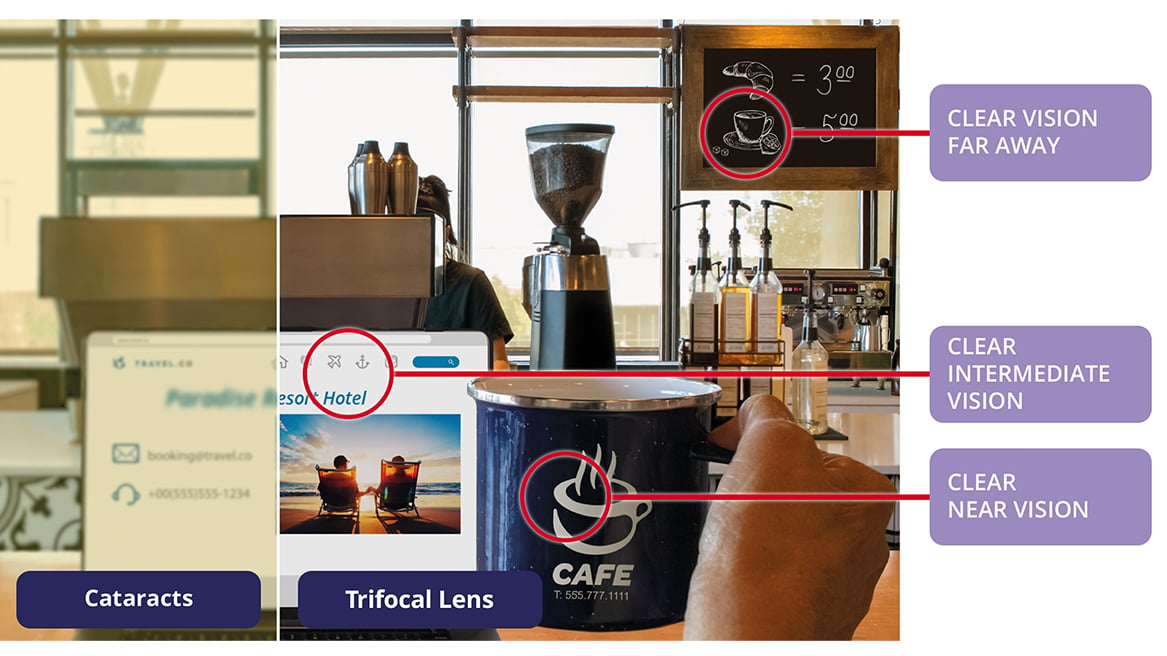
TRIFOCAL LENS (DAYTIME)
Clear distance, clear intermediate and excellent near vision4-6
TRIFOCAL LENS (NIGHTTIME)
Clear distance, clear intermediate and excellent near vision1,2
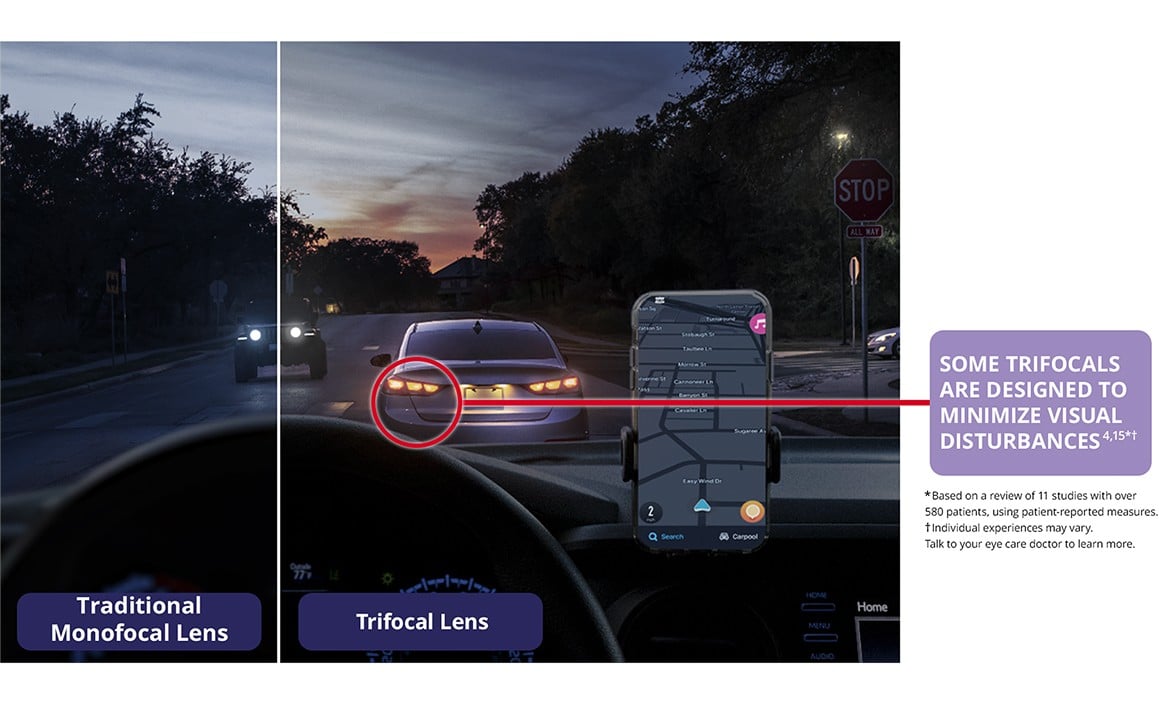
You may experience visual disturbances such as a halo around bright lights.13,15 Over time, these may become less prominent or disappear.16
AT A GLANCE
Comparing IOL Lenses
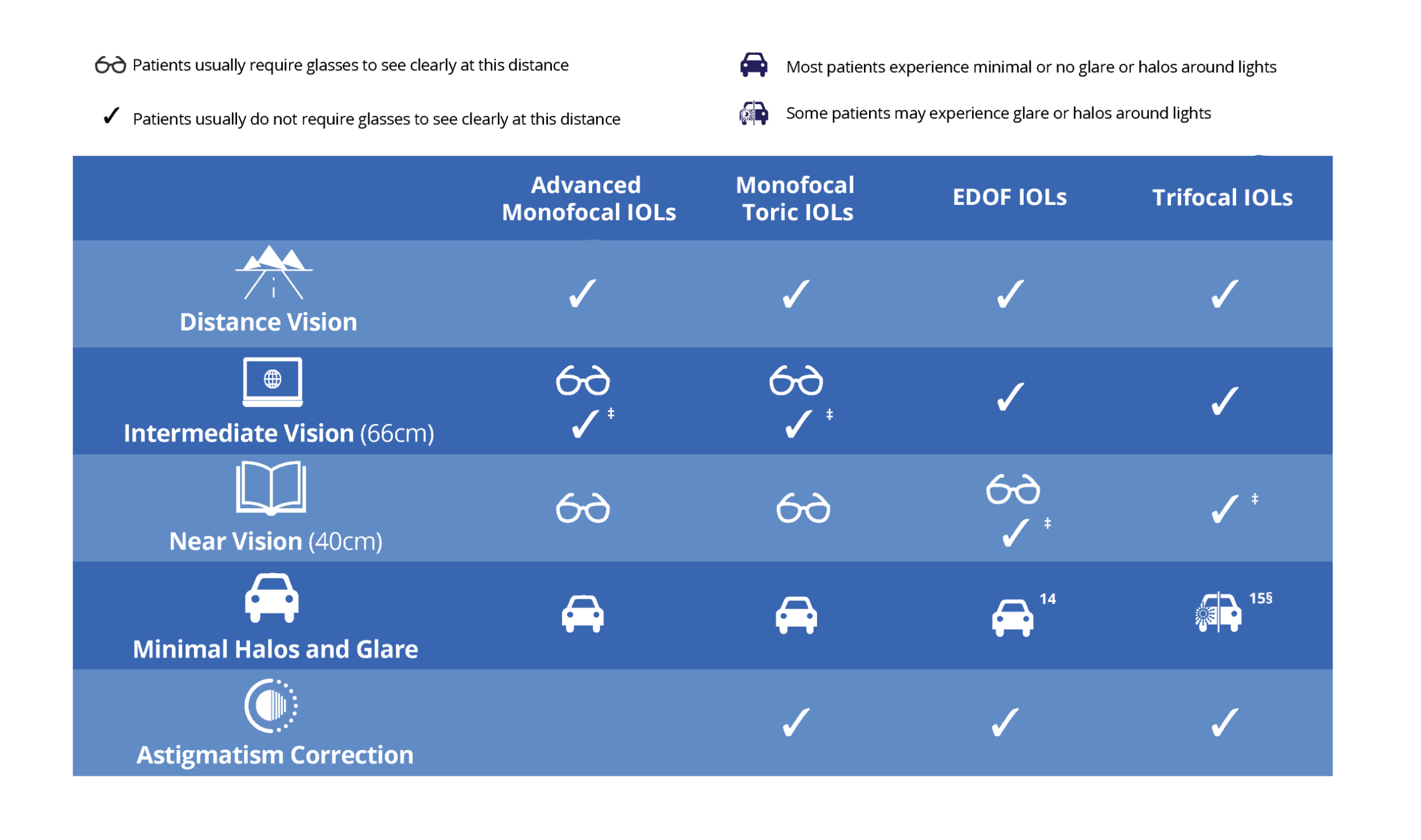
‡Functional vision typically allows most people to see adequately at a given distance for daily activities, but glasses may be needed for more concentrated work such as reading small font, reading for extended periods, or reading in low light conditions.
§Some patients may experience visual disturbances such as a halo around bright lights.
What happens during cataract surgery?
Cataract surgery is an exciting opportunity to renew your vision and see life clearly again.
The procedure is usually completed within 10 to 20 minutes.17

The surgeon removes your clouded lens and replaces it with a new, artificial lens
You’ll receive local anesthetics to numb the area around your eye, and you may be given a sedative to help you relax.18

Recovery after cataract surgery is usually very quick
You will likely be able to go home on the same day as your surgery. Within a few days most patients can return to their daily activities, with vision improving over time.18
After surgery, your doctor will monitor the healing process
Patients usually see their doctor a day or two after surgery, the following week, and then again after one month.18
Intraocular lenses (IOLs) are used in cataract surgery to replace the natural lens of the eye. Extraction of a cataract and replacement with an IOL will require surgery and all surgery carries risks. Please consult your eye care professional to determine if this product is right for you. If you experience any symptoms, consult your eye care professional as the symptoms may be a sign of other eye problems.
What kind of vision would you like after surgery?
The kind of vision you'd like after surgery is one of the factors that determines the type of lens your surgeon may recommend for you. Basic Monofocal IOLs offer clear vision at a single distance, typically far.19 Presbyopia-correcting lenses (like multifocal and extended depth-of-focus [EDOF] IOLs) provide a broader range of vision, helping you see near, intermediate, and far with less or no dependence on glasses.7-9 For those with astigmatism, toric IOLs are designed to provide optimal astigmatism correction after cataract surgery.13
Your lifestyle, visual goals, and budget all play a role in selecting the right lens, so discussing these factors with your ophthalmologist is essential for achieving the best outcome.

Consult your doctor about the available treatment options/products and on the relevant safety information.
Please refer to relevant product direction for use for complete list of indications, contraindications and warnings.
REFERENCES
1. Cataracts. Mayo Clinic Website. Updated September 28, 2023. Accessed October 24, 2025. https://www.mayoclinic.org/diseases-conditions/cataracts/symptoms-causes/syc-20353790.
2. Maxwell A, Suryakumar R. Long-term effectiveness and safety of a three-piece acrylic hydrophobic intraocular lens modified with hydroxyethyl-methacrylate: an open-label, 3-year follow-up study. Clin Ophthalmol. 2018;12:2031-2037.
3. MarketScope LLC. 2024 Premium Cataract Surgery Market Report. Published October 2024. St. Louis, MO: MarketScope LLC; 2024.
4. Alcon Vision LLC. Clareon® PanOptix® Trifocal Hydrophobic Acrylic IOL. Product Information. 2021.
5. Zhu D, Ren S, Mills K, Hull J, Dhariwal M. Rate of complete spectacle independence with a trifocal intraocular lens: A systematic literature review and meta-analysis. Ophthalmology and Therapy. 2023;12(2):1157-1171.
6. Masters JS. Presbyopia-Correcting IOLs. American Academy of Ophthalmology (AAO). September 18, 2024. Accessed October 29, 2025. https://eyewiki.org/Presbyopia-Correcting_IOLs.
8. Alcon Data on File, 2019. [REF-01412].
9. McCabe C, et al. Clinical outcomes in a U.S. registration study of a new EDOF intraocular lens with a non-diffractive design. J Cataract Refract Surg. 2022;48(11):1297-1304.
10. Alcon Data on File, 2025. [REF-28449].
11. Micheletti JM, Duncan NB, Hall B. Head-to-Head Comparison of Intermediate Vision of Two Monofocal Intraocular Lenses. Clinical Ophthalmology. 2023 Dec 31:3983-90.
12. Das KK, Werner L, Collins S, Hong X. In vitro and schematic model eye assessment of glare or positive dysphotopsia-type photic phenomena: Comparison of a new material IOL to other monofocal IOLs. J Cataract Refract Surg. 2019;45(2):219-227.
13. terHorst C. American Academy of Ophthalmology (AAO). "Choosing an Artificial Lens for Cataract Surgery." Available at: https://www.aao.org/eye-health/treatments/best-artificial-lens-IOL-cataract-surgery. Accessed: October 25, 2021.
14. Sherrell Z. Everything to Know About Extended Depth of Focus (EDOF). April 30, 2025. Accessed October 30, 2025. https://www.medicalnewstoday.com/articles/edof.
15, Zhu D., Zhang J., et al. Patient-Reported Outcomes of Visual Disturbances with a Trifocal Intraocular Lens: A meta-analysis. Paper presented at: ASCRS Annual Meeting; April 5-8, 2024; Boston.
16. Modi S, Lehmann R, Maxwell A, et al. Visual and Patient-Reported Outcomes of a Diffractive Trifocal Intraocular Lens Compared with Those of a Monofocal Intraocular Lens. Ophthalmology. 2021;128(2):197-207.
17. Haddrill M. Cataract surgery recovery: 8 tips to minimize recovery time. All About Vision. Updated February 26, 2019. Accessed October 24, 2025. https://www.allaboutvision.com/treatments-and-surgery/vision-surgery/cataract/cataract-surgery-recovery/.
18. Cataract Surgery. Mayo Clinic web page. Updated September 9, 2023. Accessed October 24, 2025. https://www.mayoclinic.org/tests-procedures/cataract-surgery/about/pac-20384765.
19. Sridhar U, Tripathy, K. Monofocal Intraocular Lenses. NCBI Bookshelf. Updated July 24, 2022. Accessed October 24, 2025. https://www.ncbi.nlm.nih.gov/books/NBK580484/.