Trifocal Intraocular Lens (IOL)
Helps you to see up close, far away, and at arm’s length.
It can reduce your need to wear glasses.1-5
Trifocal Intraocular Lens (IOL)
Helps you to see up close, far away, and at arm’s length. It can reduce your need to wear glasses.1-5
Experience Full Range of Vision and Exceptional Clarity1,3,5,6
With a trifocal lens, it can not only correct your cataract, but also address other vision issues like nearsightedness (myopia), astigmatism, or presbyopia.7 It offers sharp, crisp vision at distance and near with reduced dependence on glasses.1-3 At the same time, some trifocal lenses are also designed to help minimize bothersome visual disturbances like halos and glares.1,8
When you can see more, you can do more. Redefine your vision with a presbyopia-correcting trifocal IOL, and start seeing life differently.

Majority of trifocal lens recipients never require spectacles at any distance3
Enjoy a full range of vision and exceptional clarity,* and reduce your need for glasses.1,3,6 Suitable for your digital device lifestyle with clear near vision.2,9
*Based on in vitro examinations of glistenings, surface haze, and SSNGs.

Benefits of Trifocal IOLs

Enhance your vision for clear, complete focus.1,2,6
Discover bright, vivid colours.10
Some trifocal lenses provide very low levels of bothersome visual disturbances like halos and glare.8†
Most patients reported never needing glasses at all distances.3‡
†Based in a meta-analysis of 11 unique clinical studies with 580 patients in 10 different countries, including "very bothersome” and "severe" visual disturbances.
‡Based on a meta-analysis of 13 studies with a total of more than 600 patients.
Know Your Options. Put Your Future in Focus.
A trifocal lens gives you a full range of vision, so that you can immerse yourself in a full range of activities—all while relying less on glasses.1,3
Here’s a visual example to help you understand the kind of vision improvements that come with a trifocal IOL.
TRIFOCAL LENS (DAYTIME)
Clear distance, clear intermediate and excellent near vision1,2
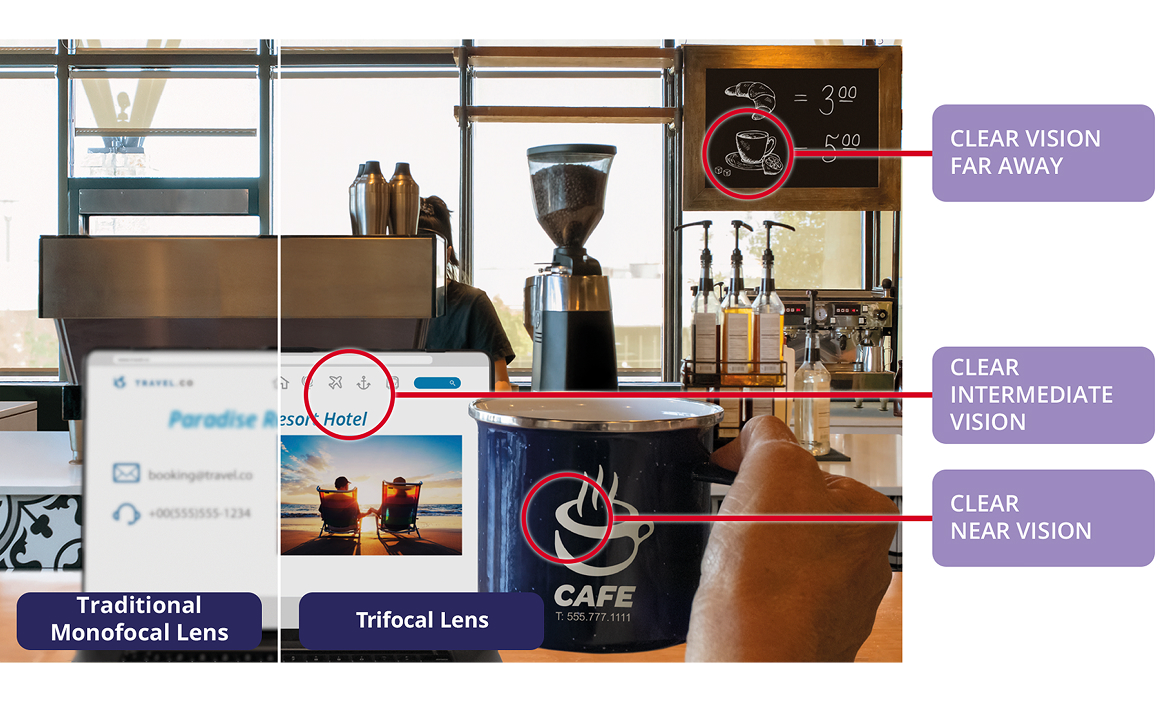
For illustration purposes only; personal experiences may vary.
TRIFOCAL LENS (NIGHTTIME)
Clear distance, clear intermediate and excellent near vision1,2
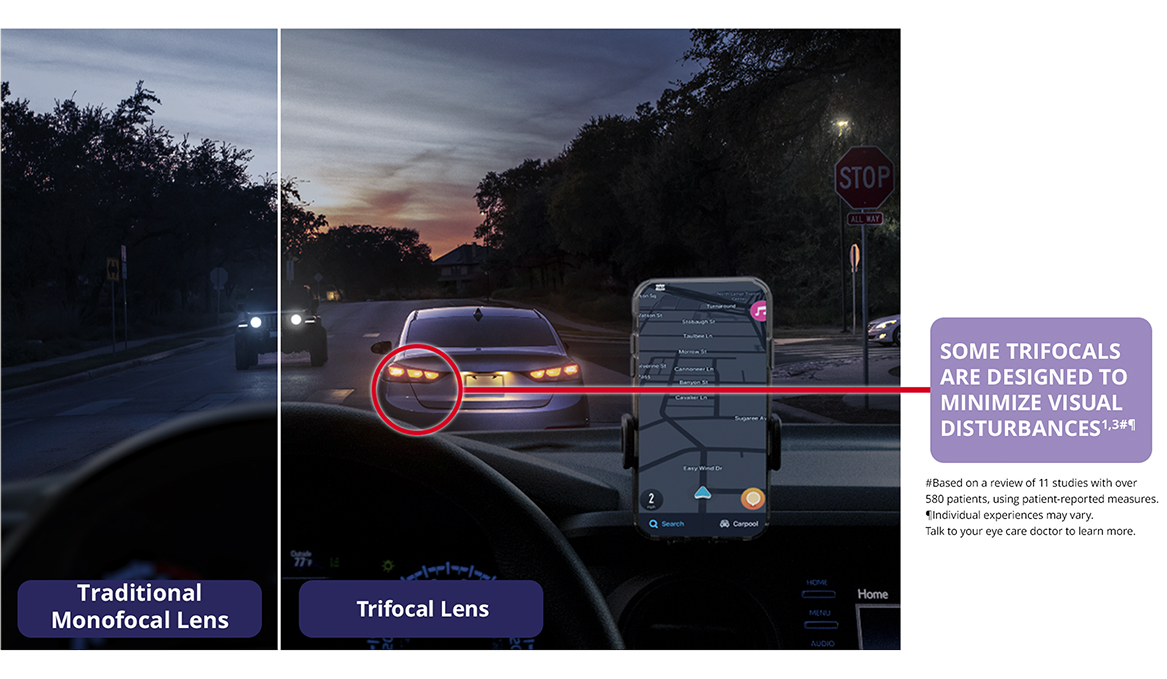
You may experience visual disturbances such as a halo around bright lights.4,8 Over time these may become less prominent or disappear.11
Frequently Asked Questions About
Trifocal IOLs
Get the information you need to guide you to an informed decision about the cataract lens replacement that best fits your budget and your lifestyle.
A presbyopia-correcting trifocal IOL is a type of intraocular lens that is used to replace the natural lens of the eye during cataract surgery.4 Like a trifocal eyeglass lens, a trifocal IOL contains three different prescriptions in one lens, allowing the patient to see clearly at far, intermediate, and near distances reducing, or sometimes eliminating, the need for glasses or contacts.1-5
You may have options when it comes to cataract surgery. Choosing the right IOL for your needs is a personal decision that should be discussed with your eye surgeon. Generally, trifocal IOLs can be a good option for people who:
• Want to reduce their dependence on glasses: Trifocal IOLs are designed to provide good vision at far, intermediate, and near distances, which can reduce the need for glasses or contacts, or even eliminate it altogether.1,3
• Have realistic expectations: While trifocal IOLs can improve vision at multiple distances, they may not completely eliminate the need for glasses or contacts1,3, and some patients may experience visual side effects such as halos or glare.5,8
• Are willing to pay some of the cost out-of-pocket: Due to its advanced technology, trifocal IOLs are typically more expensive than monofocal lenses, which may be a consideration for some patients.12,13
Typically, an insurance company will not cover elective parts of cataract surgery, including different types of IOL and laser-assisted cataract surgery. This means that, if you want a trifocal IOL, you may need to pay out of pocket for at least part of the procedure.12,13 But if the possibility of enjoying a full range of vision so that you can immerse in a full range of activities—all while relying less on glasses—is important to you, the benefits may outweigh the cost.1,3 Learn more about the cost of cataract surgery and insurance coverage. [LINK TO: /cost-and-insurance-coverage]
Yes, there are trifocal toric IOLs that are suitable for people with astigmatism.4 Ask your doctor to learn more about your options.
The journey to clear vision after cataracts starts with knowing the difference between cataract replacement lens options.
Learn about your options to find the right type of IOL for you.
Consult your doctor about the available treatment options/products and on the relevant safety information.
Please refer to relevant product direction for use for complete list of indications, contraindications and warnings.
REFERENCES
1. Kohnen T, Lapid-Gortzak R, Ramamurthy D, et al. Clinical outcomes after bilateral implantation of a diffractive trifocal intraocular lens: A worldwide pooled analysis of prospective clinical investigations. Clin Ophthalmol. 2023;17:155-163. Clin Ophthalmol. 2023;17:3983-3990.
2. Zhu D, Ren S, Mills K, Hull J, Dhariwal M. Rate of complete spectacle independence with a trifocal intraocular lens: A systematic literature review and meta-analysis. Ophthalmol Ther. 2023;12(2):1157-1171.
3. terHorst C. Choosing an Artificial Lens for Cataract Surgery. American Academy of Ophthalmology (AAO). Accessed November 1, 2021. https://www.aao.org/eye-health/treatments/best-artificial-lens-IOL-cataract-surgery
4. Masters JS. Presbyopia-Correcting IOLs. American Academy of Ophthalmology (AAO). September 18, 2024. Accessed October 29, 2025. https://eyewiki.org/Presbyopia-Correcting_IOLs
5. Lehmann R, Maxwell A, Lubeck DM, Fong R, Walters TR, Fakadej A. Effectiveness and safety of the CLR® Monofocal Intraocular Lens: Outcomes from a 12-month single-arm clinical study in a large sample. Clin Ophthalmol. 2021;15:1647-1657.
6. Alió JL, Grzybowski A, Romaniuk D. Refractive lens exchange in modern practice: when and when not to do it?. Eye Vis (Lond). 2014;1:10.
7. Zhu D, Karki S, Dhariwal M, Soini E, Asseburg C. Patient-Reported outcomes of visual disturbances with a trifocal intraocular lens: A meta-analysis. Ophthalmol Ther. 2025;14(2):379-390.
8. ANSI Z80.29-2015. ANSI Webstore. Accessed October 6, 2025. https://webstore.ansi.org/standards/vc%20(asc%20z80)/ansiz80292015.
9. Groessl EJ, Liu L, Sklar M, Tally SR, Kaplan RM, Ganiats TG. Measuring the impact of cataract surgery on generic and vision-specific quality of life. Qual Life Res. 2013;22(6):1405-1414.
10. Modi S, Lehmann R, Maxwell A, et al. Visual and Patient-Reported Outcomes of a Diffractive Trifocal Intraocular Lens Compared with Those of a Monofocal Intraocular Lens. Ophthalmology. 2021;128(2):197-207.
11. Your Sight Matters. What is the Cost of Cataract Surgery?. Accessed October 30, 2025. https://yoursightmatters.com/cataracts/what-is-the-cost-of-cataract-surgery/
12. Hill A. Cataract Surgery Cost. Vision Center. Updated October 1, 2024. Accessed July 16, 2025. https://www.visioncenter.org/conditions/cataracts/surgery-cost/