Advanced Monofocal Toric Intraocular Lens (IOL)
An advanced monofocal toric IOL corrects astigmatism and provides functional intermediate vision while maintaining exceptional sharp, crisp distance vision.1-4
You will likely need glasses to see up close.
Advanced Monofocal Toric Intraocular Lens (IOL)
An advanced monofocal toric IOL corrects astigmatism and provides functional intermediate vision while maintaining exceptional sharp, crisp distance vision.1-4 You will likely need glasses to see up close.
Start Your Journey Towards a Future Without Cataracts and Astigmatism
Advanced monofocal toric IOLs deliver functional intermediate vision and sharp, crisp distance vision while correcting astigmatism at the same time.4,5
Astigmatism is a separate, common eye condition that happens when the cornea’s surface has an uneven curvature, resembling a rugby ball rather than a football. This irregularity results in blurred vision at all distances and challenges in seeing fine details.6
By choosing advanced monofocal toric IOLs, you can correct this corneal irregularity and gain exceptional clarity.4,7,8

Know Your Options. Put Your Future in Focus.
Here’s a visual example to help you understand the kind of vision improvements that come with an advanced monofocal toric IOL.
ADVANCED MONOFOCAL TORIC LENS
Clear distance and functional intermediate vision
with astigmatism correction1-4
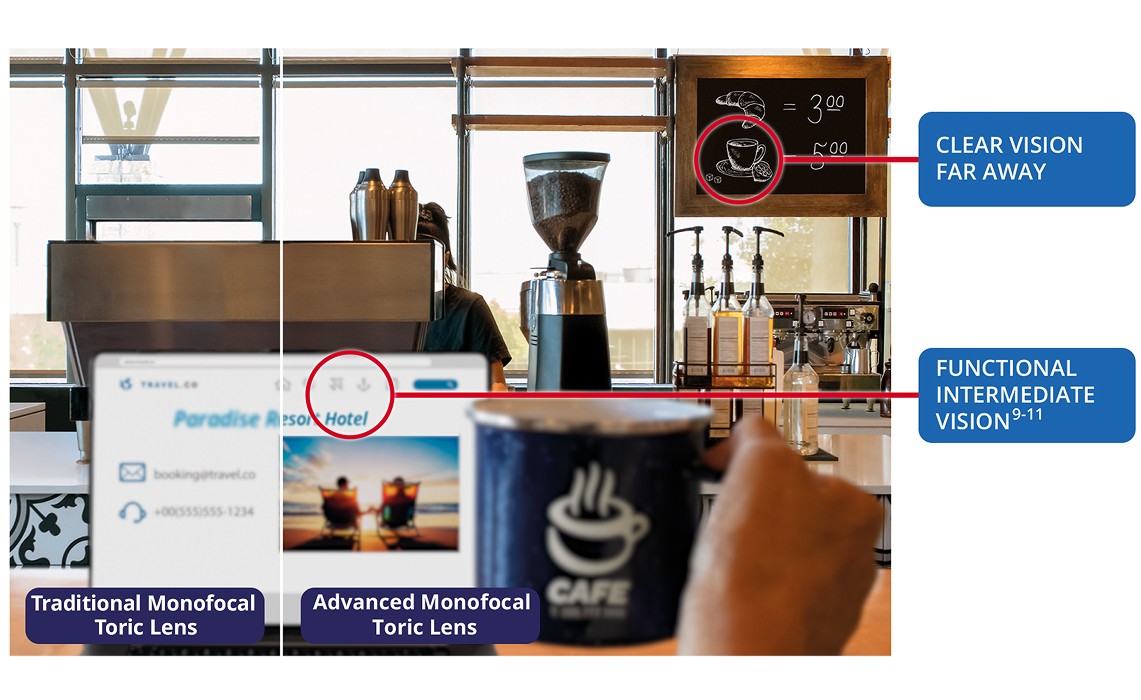
For illustration purposes only; personal experiences may vary.
Toric IOLs come in a range of vision options, from monofocal to premium lenses. You have a choice when it comes to the right type of IOL for you.
Frequently Asked Questions About Advanced Monofocal Toric IOLs
Get the information you need to guide you to an informed decision about the cataract lens replacement that best fits your budget and your lifestyle.
Cataracts occur when proteins build up in your eye's natural lens, causing cloudy vision and making everyday tasks, like driving, using a computer, or recognizing familiar faces, more difficult.12
Astigmatism is a separate, common eye condition that happens when the cornea's surface has an uneven curvature, resembling a rugby ball rather than a football. This irregularity results in blurred vision at all distances and challenges in seeing fine details.6
By choosing a toric lens (IOL), you can effectively address both the vision problems caused by cataracts and astigmatism simultaneously.13
If you have cataracts and astigmatism, the answer is likely yes. Ask your surgeon if you’re a candidate for any of the astigmatism-correcting lens options.
When you're preparing for cataract surgery, choosing the right lens (IOL) is an important decision—and one that should be made through discussions with your eye surgeon. With Monofocal Toric IOLs, you can gain exceptional clarity and correct astigmatism at the same time.4,7,8You may be a good candidate if4,13:
• You want to correct both your cataracts and astigmatism at the same time
• You’re looking for sharp distance vision—like for driving, watching TV, or seeing things clearly across a room
• You’re comfortable wearing glasses for up-close activities like reading or sewing
• You want functional intermediate vision, meaning you don’t need glasses for working on a computer, reading a menu, seeing in a mirror, etc.
• You don’t have other eye conditions that might affect your vision
If this sounds like you, the Advanced Monofocal Toric IOLs could be a great fit. But remember—every eye is unique. The best way to know what’s right for you is to talk to your eye surgeon, who can recommend a lens based on your lifestyle and vision goals.
Consult your doctor about the available treatment options/products and on the relevant safety information.
Please refer to relevant product direction for use for complete list of indications, contraindications and warnings.
REFERENCES
1. Varma D, et al. Clinical outcomes of a new non-diffractive presbyopia-correcting intraocular lens from two large confirmatory studies. AAO. Abstract: PA005.
2. Bala C, Poyales F, Guarro M, et al. Multicountry clinical outcomes of a new nondiffractive presbyopia-correcting IOL. J Cataract Refract Surg. 2022;48(2):136-143.
3. terHorst C. Choosing an Artificial Lens for Cataract Surgery. American Academy of Ophthalmology. Accessed October 25, 2025. https://www.aao.org/eye-health/treatments/best-artificial-lens-IOL-cataract-surgery.
4. Micheletti JM, Duncan NB, Hall B. Head-to-Head Comparison of Intermediate Vision of Two Monofocal Intraocular Lenses. Clinical Ophthalmology. 2023 Dec 31:3983-90.
5. Astigmatism: Causes, Symptoms, Diagnosis, and Treatment. WebMD. Updated November 9, 2020. Accessed October 30, 2025. https://www.webmd.com/eye-health/astigmatism-eyes.
6. Werner L, Thatthamla I, Ong M, et al. Evaluation of clarity characteristics in a new hydrophobic acrylic IOL in comparison to commercially available IOLs. J Cataract Refract Surg. 2019;45(10):1490-1497.
7. Stanojcic N, O'Brart D, Hull C, et al. Visual and refractive outcomes and glistenings occurrence after implantation of 2 hydrophobic acrylic aspheric monofocal IOLs. J Cataract Refract Surg. 2020;46(7):986-994.
8. Varma D, et al. Clinical outcomes of a new non-diffractive presbyopia-correcting intraocular lens from two large confirmatory studies. AAO 2020. Abstract: PA005.
9. Bala C, Poyales F, Guarro M, et al. Multicountry clinical outcomes of a new nondiffractive presbyopia-correcting IOL. J Cataract Refract Surg. 2022;48(2):136-143.
10. Alcon Data on File, 2022. [REF-15172].
11. Cataracts. Mayo Clinic. Updated September 28, 2023. Accessed October 30, 2025. https://www.mayoclinic.org/diseases-conditionals/cataracts/symptoms-causes/syc-20353790.
12. Cataract Surgery. Mayo Clinic. Updated September 9, 2023. Accessed October 30, 2025. https://www.mayoclinic.org/tests-procedures/cataract-surgery/about/pac-20384765.