Advanced Monofocal Intraocular Lens (IOL)
An advanced monofocal IOL provides exceptional clarity for distance, and functional intermediate vision.1 You will likely need glasses to see up close.
Advanced Monofocal Intraocular Lens (IOL)
An advanced monofocal IOL provides exceptional clarity for distance, and functional intermediate vision.1 You will likely need glasses to see up close.
Start Your Journey Toward a Future without Cataracts
Advanced monofocal intraocular lenses (IOLs) provide sharp, crisp distance vision and functional intermediate vision.2,3
For those with astigmatism, you may consider an advanced monofocal toric IOL.4

Benefits of Advanced Monofocal IOLs

Provides excellent distance vision.1
Delivers functional intermediate vision for activities like working on a computer or reading a menu.1,5-7
What Vision Outcomes to Expect with
an Advanced Monofocal IOL
Here’s a visual example to help you understand the kind of vision improvements that come with an advanced monofocal IOL.
ADVANCED MONOFOCAL LENS
Clear distance and functional intermediate vision2,3
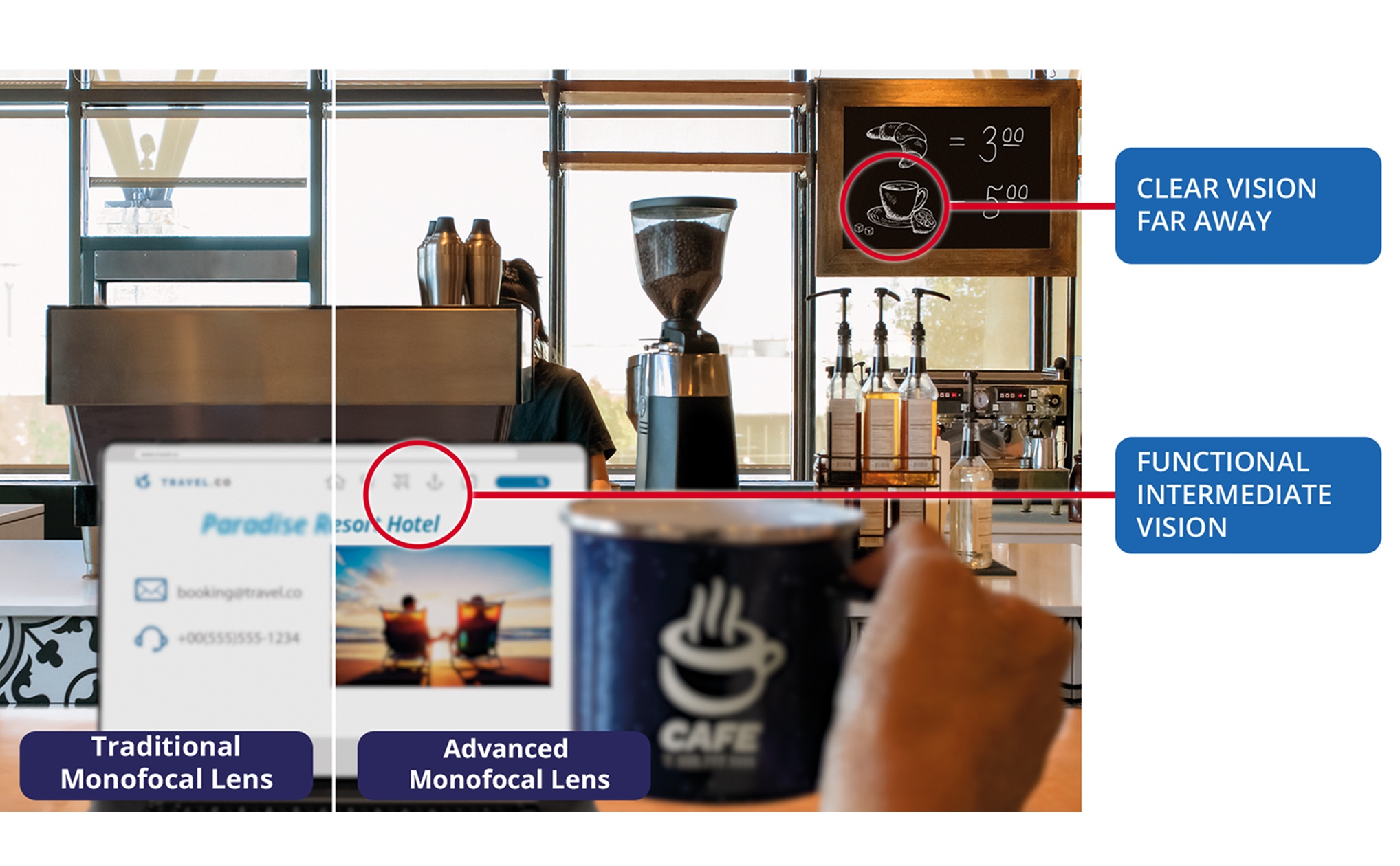
For illustration purposes only; personal experiences may vary.
Frequently Asked Questions
Get the information you need to guide you to an informed decision about the cataract lens replacement that best fits your budget and your lifestyle.
While monofocal IOLs are typically designed to improve distance vision only,4 advanced monofocal IOLs provide excellent distance and functional intermediate vision.2,3 Alternatively, trifocal and EDOF (or Extended Depth of Focus) lenses are great options for people who want to reduce their dependence on glasses or contact lenses after cataract surgery.4 Consult with your doctor to determine which lens technology fits your lifestyle best. You may have options—compare the various IOL technologies here.
A monofocal IOL (intraocular lens) is a lens that is surgically implanted in the eye to replace the natural lens that has become cloudy due to cataracts. This lens can provide clear distance vision, but it cannot adjust to focus on objects at varying distances. Therefore, glasses or contact lenses may still be required to correct near or intermediate vision.4 However, unlike typical monofocal lenses, an advanced monofocal IOL provides excellent distance and functional intermediate vision.1-3
You can have options when it comes to cataract surgery. Choosing the right IOL lens for your needs is a personal decision that should be discussed with your eye surgeon. Here are some general guidelines to help determine if an advanced monofocal IOL is right for you1:
• You are primarily concerned with achieving clear distance vision
• You want functional intermediate vision, meaning you don't need glasses for working on a computer, reading a menu, seeing in a mirror, etc.
• You do not mind wearing glasses or contact lenses for near vision
• You have no other significant eye conditions that may affect your vision
If this sounds like you, an advanced monofocal IOL may be an excellent choice. However, keep in mind that everyone's eyes are different, and a thorough consultation with an experienced eye surgeon is essential to determine the best course of treatment for your specific needs.
Learn more about the cost of cataract surgery and insurance coverage.
Advanced monofocal IOLs are only one option. You may have a choice when it comes to the right type of IOL for you.
Consult your doctor about the available treatment options/products and on the relevant safety information.
Please refer to relevant product direction for use for complete list of indications, contraindications and warnings.
REFERENCES
1. Micheletti JM, Duncan NB, Hall B. Head-to-Head comparison of intermediate vision of two monofocal intraocular lenses. Clin Ophthalmol. 2023;17:3983-3990.
2. Modi S, Lehmann R, Maxwell A, et al. Visual and patient-reported outcomes of a diffractive trifocal intraocular lens compared with those of a monofocal intraocular lens. Ophthalmology. 2021;128(2):197-207.
3. Clareon® IOL Directions for Use.
4. terHorst C. American Academy of Ophthalmology (AAO). "Factors to Consider in Choosing an IOL for Cataract Surgery." Available at: https://www.aao.org/eye-health/tips-prevention/best-artificial-lens-implant-iol-cataract-surgery. March 31, 2025. Accessed November 20, 2025.
5. AcrySof® Vivity® Extended Vision IOL Directions for Use.
6. Varma D, et al. Clinical outcomes of a new non-diffractive presbyopia-correcting intraocular lens from two large confirmatory studies. Presented at AAO, November 13-15, 2020. Abstract: PA005.
7. Bala C, Poyales F, Guarro M, et al. Multicountry clinical outcomes of a new nondiffractive presbyopia-correcting IOL. J Cataract Refract Surg. 2022;48(2):136-143.